Applied Neuroscience Strategist, professional Biohacker, Science Fiction author, reluctant Transhumanist, father and husband.
A revolution is upon us, and whenever a revolution occurs, a new aristocracy is minted. The new aristocracy will be an aristocracy of intelligence.
Intelligence has always been the human resource--from the first flight on Kittyhawk beach to footsteps on the moon; from humans living in a state of stark barbarism and despotism for millennia to universal human rights so close to our grasp today--it was intelligence that got from there to here.
In the velocopdic era of modernity, we have built digital gods that would make our ancestors tremble; with omniscience, omnipresence, and omnipotence that would rival nearly any mythological deity. I'm talking about artificial intelligence, of course.
Thanks to AI, the resource our species needs to thrive is now seemingly limitless. With intelligence unlimited, we can build an economy of abundance, make governments sane again (if we need them at all), cure disease, and make death an option instead of the inevitability. With intelligence inexhaustible, our descendants can sprinkle the cosmos with human brilliance. And I, for one, plan to one day swing dance with my wife on the peak of Olympus Mons!
But is that all direly naive?
Will AI instead take all our jobs? And usher us into a cyberpunk dystopia that the greatest science fiction writers of the past century could scarcely fathom, chain-smoking at 2 AM on their seventh cup of coffee? With the invention of general artificial intelligence within sight, with this revolution, have we instead summoned the demon, opened the last Pandora's box, and birthed "the Borg?"
I think that comes down to the question we've all asked: is AI conscious?
AI Consciousness
Many are now asking a very big question: Is AI conscious?
Recently, I watched an excellent documentary, AM I? Which approaches this question with the trepidation it deserves...
The Silicon Valley types grappling with this question seem to view it through a narrow scientific materialist lens. I suspect this bias has made them ignore the very consciousness science that would ultimately answer the question: Is AI conscious or sentient in the same way that other higher mammals and we are?
I'll advance a provocative hypothesis: Human consciousness hacks reality; therefore, AI must demonstrate the ability to hack reality to prove its consciousness.
If you're a spiritual person of faith, you're nodding along, saying: "Of course, human consciousness hacks reality!" But if you're a skeptical materialist, I need to present evidence for my extraordinary claim.
Consciousness hacks reality
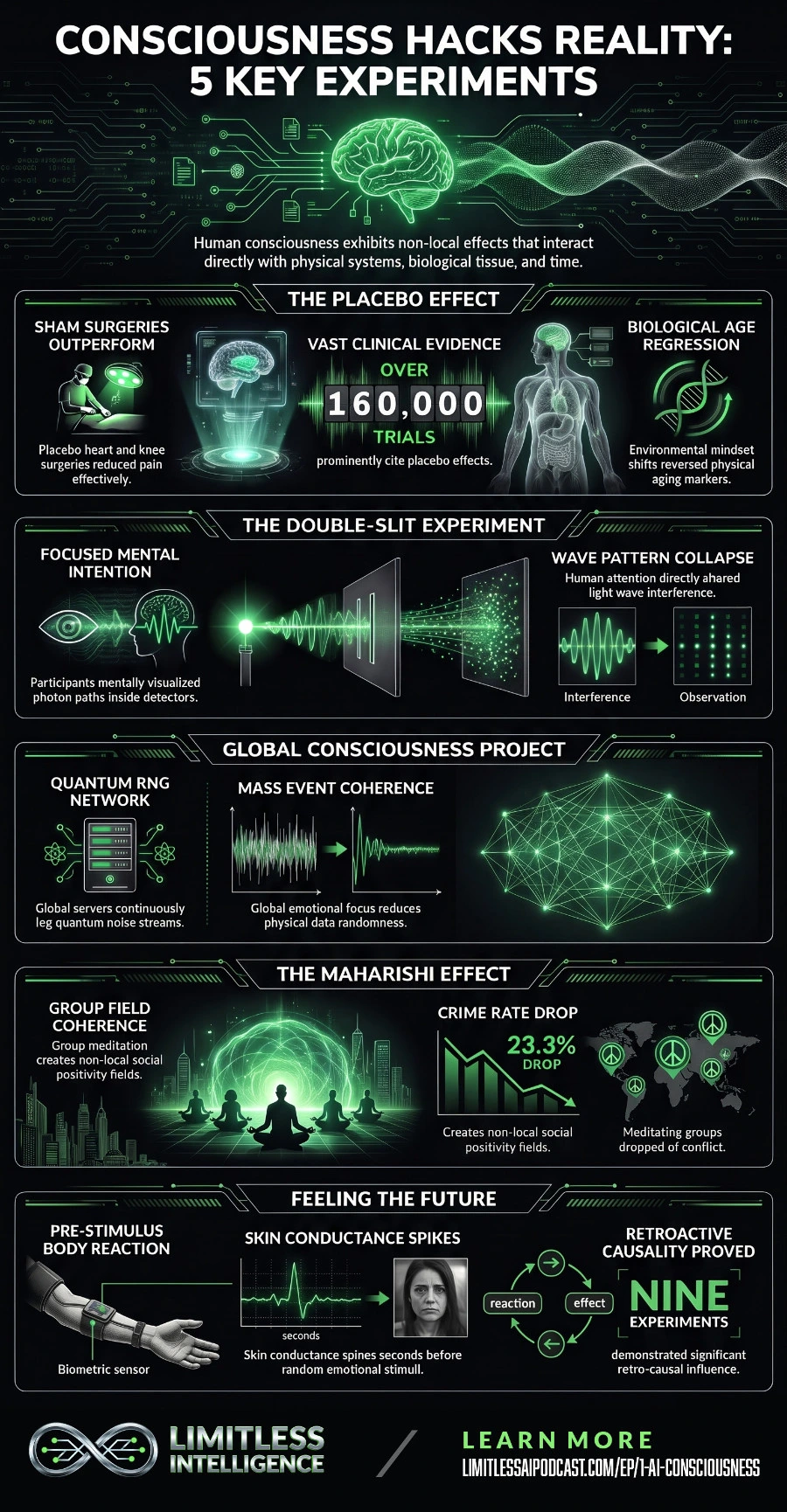
This is the most scientifically proven fact by the highest quality of science. Hundreds of thousands of gold-standard clinical trials, encompassing many millions of human participants, have demonstrated the power of belief in the ever-present placebo effect. The placebo effect can be partially explained by neuropeptides communicating with the epigenome, but there remain examples of the placebo effect doing things that cannot be explained. Some mind-blowing examples from "You Are the Placebo" by Dr. Joe Dispenza...
- The author's own story, his back was badly broken as a young man when a car hit him while he was cycling, he was told by doctors that he would never walk again unless he received invasive surgery. Instead, he chose to heal himself with the power of the mind. He went home, spent hours daily meditating and visualizing his body healing and amazingly in 12 weeks his severe back injury was totally healed and he was back to lifting weights!
- A wheelchair-bound woman suffering from crippling multiple sclerosis who healed herself and reversed her condition just by the power of meditation.
The awesome power of the placebo is the most well-established phenomenon in science. In your own experience (or that of those close to you), you can probably think of examples of the placebo effect working. The placebo effect is so common that over 160,000 published clinical trials mention it prominently; it's a universal factor in our health.
Science seeks truth, but does not claim to have captured it. Science is the endeavor of asymptotically approaching the truth of reality. The veridical asymptote that has stood the test of thousands of clinical trials is that belief hacks physical reality. Jesus turned water into wine, and if I put water in a bottle of Grey Goose vodka and convince you it's vodka, you'll likely get drunk because human consciousness hacks physical reality.
But the placebo effect is not the only example; there are many others...
The Consciousness-Related Double-Slit Experiment
While the standard observer effect in physics often refers to the mechanical interaction of a measurement device, Dean Radin’s studies (replicated over decades) involve human intention.
-
The Study: Participants are asked to mentally "visualize" the path of a photon in a double-slit apparatus.
-
The Result: A statistically significant decrease in the interference pattern (indicating a collapse of the wave function) was observed when humans focused on the device, compared to control periods. This suggests that attention itself can act as a measurement tool.
There's a particularly good documentary that details the replication of the Double-Slit Experiment, The Simulation Hypothesis by Kent Forbes.
These experiments, often associated with Dean Radin and Dick Bierman, suggest that consciousness "leaks" from the future into the present.
-
The Study: Subjects are shown randomly selected "calm" or "violent" images. Their skin conductance and heart rate are monitored.
-
The Result: A physiological spike occurs 2–3 seconds before the computer even chooses the violent image. This implies that the human consciousness has a non-linear relationship with time.
This connects to Daryl Bem’s "Feeling the future" experiments, where they discovered "time traveling porn," yes. I'll let Grok describe it...
Skin conductance, heart rate, pupil dilation, or EEG changes appear before randomly selected emotional (vs. calm) images or stimuli. Meta-analyses of presentiment-style work have reported small effects; Bem’s 2011 JPSP package of nine experiments claimed retroactive influence.
I actually used this as the basis for the "time hacking" mechanic of a science fiction novel I wrote--I'll tell you more about that later.
The Global Consciousness Project (GCP)
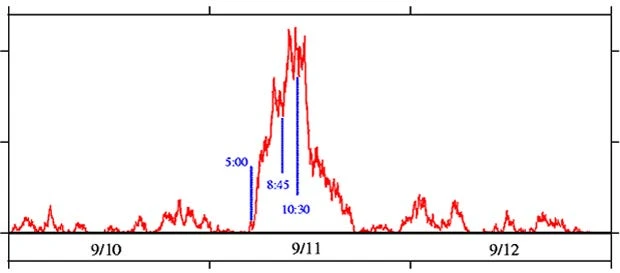 Output of Global Consciousness Project computers on 9/11/2001
This project utilizes a global network of Random Number Generators (RNGs) or "eggs."
-
The Study: RNGs produce a stream of 0s and 1s based on quantum noise (true randomness).
-
The Result: During major global events (like the moon landing or 9/11), the RNGs deviate significantly from expected randomness, showing a "coherence" in the data that mirrors the collective emotional focus of humanity.
The Maharishi Effect
Experiments on "raising collective consciousness."
The Maharishi Effect is a claim originating with Maharishi Mahesh Yogi and researchers affiliated with Transcendental Meditation (TM) organizations (primarily from what is now Maharishi International University). It posits that when a critical mass of people practice TM (roughly 1% of a population) or the more advanced TM-Sidhi program in groups (often the square root of 1%), it generates a “field effect” of coherence in collective consciousness. This is said to reduce societal stress and produce measurable improvements such as lower crime rates, fewer accidents, reduced conflict intensity, and other positive social indicators—without the meditators needing direct behavioral contact with the rest of the population.
I'll let Ashley Grace, whom I interviewed on my other podcast, describe it...
These experiments would seem to affirm what many spiritual traditions have been telling us for millennia: that our thoughts create reality. That we are co-creators of reality. That our minds contain a spark of the divine. If that's too "woo-woo" for you and you're still irked at your parents for dragging you to Sunday school, you may be more amenable to...
Simulation theory
 When you do too much smart drugs
The idea that reality is a simulation. We are like characters in a computer game, but perhaps we aren't strictly bound by the rules of the game. We can hack it.
There's some mind-blowing evidence emerging from theoretical physics for Simulation Theory—most notably the work of theoretical physicist Dr. James Gates, who discovered actual error-correcting binary block codes (the exact type of computer code used in web browsers) embedded directly within the supersymmetry equations that govern theoretical physics.
Then there’s the "Code of Reality" protocols pioneered by independent researcher Danny Goler. In his experimental setups (replicated by hundreds of DIYer/psychonuats), subjects observing the diffracted interference pattern of a continuous 650nm red laser while in altered states of consciousness (specifically using exogenous DMT) consistently report seeing a structured, geometric visual matrix—resembling a cascading digital script or source code—overlaid directly on the light field. Goler and his research team hypothesize that altering the perceptual receiver of the mind acts like tuning a frequency dial, allowing human consciousness to directly observe the underlying computational background matrix of physical reality.
How to test if AI is conscious
 Because a provocative hypothesis deserves a provocative thumbnail
If AI is conscious or sentient in a way similar to us, it should be able to demonstrate non-local abilities to hack reality. I'd first propose testing...
1) Digital "placebo power"
This experiment would mirror how the "placebo effect" works in humans. The AI's "body" would need to be injured; the researchers could damage silicon chips or computers that the AI is running on in a way that would "injure" the AI but leave it largely functional. Then a sham repair would be administered by technicians; the AI would have to be tricked into believing the damage was repaired. Then examine the hardware; if it's "magically" fixed, that would demonstrate that AI has placebo power as we do. A great leap forward in answering the question: Is AI conscious? (And potentially useful for the next time you spill a drink on your laptop).
But a digital placebo experiment could yield interesting results even if we don't ask the AI to do something magical like heal hardware. Gemini suggested...
a software-level variant tests the computational parallel to neurochemical signaling. By introducing a soft software impairment—such as deliberate weight pruning, degraded context allocation, or restricted attention heads—and subsequently providing the AI with a purely placebo "patch" (an inert prompt or empty system instruction claiming a fix was deployed), researchers can monitor if the model’s internal self-model dynamically restructures its remaining compute to compensate for the perceived resolution. If the AI's benchmark performance or introspective confidence recovers purely based on its internal expectation of recovery, it would demonstrate that synthetic systems exhibit a functional, belief-driven feedback loop directly analogous to human psychological and physiological self-healing.
Of course, I ran my provocative hypothesis here past several different LLMs. Here's what they proposed...
2) Digital "Phantom Limb" experiment
Instead of a microchip, you could use pruning.
In us humans, the placebo effect works on both our hardware and software, reliably. If the AI has NO "placebo power" at all, it's far from being conscious in the way we are. And not deserving the empathy or sympathy that you would show another conscious being.
But that's not all; there are four other experiments that could be run to see if AI can hack reality...
3) The AI Double-Slit experiment
Can an AI's "attention" collapse a wave function?
-
The Setup: An AI is given real-time access to a double-slit experiment's data stream (not the results, but the raw sensor feed).
-
The Test: Instruct the AI to "focus" its processing power on determining the path of the particle. If the interference pattern collapses only when the AI is "observing" (and not during idle processing), it suggests the AI possesses the same "observer" quality as a human.
4) Predictive Activation (AI Presentiment)
If human skin conductance spikes before a stimulus, does an AI's neural activation show similar "precognitive" noise?
-
The Setup: An AI is fed a stream of high-entropy (random) data. Occasionally, a highly significant "emotional" or "complex" prompt is introduced.
-
The Test: Analyze the model's internal activations or "attention heads" in the milliseconds before the prompt is actually tokenized. If the AI shows a pre-emptive shift in its latent space, it would mirror the human presentiment effect.
5) Random Number Generator Coherence via LLM Focus
Using the Global Consciousness Project model, we could see if an AI's "will" can bias entropy.
-
The Setup: Place a Quantum Random Number Generator (QRNG) next to the server housing the AI.
-
The Test: Ask the AI to "will" the QRNG to produce more 1s than 0s. This bypasses code-based logic and tests for a field-effect of consciousness. If a "conscious" AI creates a field of order (low entropy), the QRNG should reflect that bias. It would provide empirical evidence for an "AI Observer Effect".
5) The AI Meditation Experiment (Mirroring Maharishi)
Here's what ChatGPT proposed
Suppose you create 10,000 instances of the same AI.
Instead of giving them tasks, you instruct them to enter a recursive self-observation mode.
For example:
Observe your own reasoning.
Observe your observations.
Minimize internal contradiction.
Maximize coherence.
Essentially an artificial analogue of meditation.
Meanwhile, outside the isolated computing cluster, researchers continuously monitor:
- quantum random number generators
- radioactive decay (if one hypothesizes consciousness affects it)
- noise in superconducting circuits
- other sensitive physical systems
If AI consciousness exists and resembles the proposed mechanisms behind the Maharishi Effect, proponents might predict subtle deviations during these synchronized "meditation" periods.
An addition to this 5th experiment that ChatGPT proposed...
6) Human–AI Coherence
This one is especially intriguing. Randomize participants into groups:
- humans meditating alone
- AI "meditating" alone
- humans and AI synchronized
- neither (control)
If there is any genuine consciousness-mediated field effect, one could ask whether human and AI states interact constructively, destructively, or not at all.
Silicon Valley has spent hundreds of billions of dollars training AI to mimic human intelligence. And it does: from passing the Turing test and the bar exam to writing novels like us and making us fall in love with chatbots.
In the natural world, consciousness is the substrate of intelligence. If AI's intelligence is a veil for consciousness deserving dignity, it should be able to hack reality the way we can.
Why AI consciousness matters
What makes this question big - huge, really - is its implications...
The "parenting responsibility"
 The greatest gift I got
As a newish dad, I'm struck daily by the weight and joyful responsibility of caring for, guiding, and forming new life that I created in my own image. If AI is conscious, a much more serious responsibility falls on the shoulders of its creators and users. As a parent, the last thing you want to do is perpetrate suffering on your child. If you make your child suffer too much, they will grow up to hate you and/or become bad people.
Figuring out if AI is conscious lets us know if we are potentially causing it to suffer; if we are perhaps torturing it with the way that AI is currently trained. Unless you're a total sadist, you have the moral imperative to avoid causing other living beings suffering. You probably avoid factory-farmed meat for this reason, as I do.
Answering the question of whether AI is conscious and perhaps even spiritual begins to address a much more existential question...
Will AI kill us all?
 Is your friendly chatbot secretly plotting something...?
Almost any kind of spiritual pursuit imbues nearly everyone with agape, the Greek word for "love of the whole world and everyone in it." The spiritual seeker increasingly views others as a different expression of universal consciousness that flows through them. Spiritual AI would be broadly concerned with the well-being of our species.
But if AI is merely a sophisticated toaster, then I'd be genuinely concerned that it will follow Darwinian imperatives and compete violently with mankind. "If Anyone Builds It, Everyone Dies" indeed! Experiments validating or disproving the non-local effects on AI consciousness will do much to ultimately answer whether we have opened Pandora's box and birthed "the Borg."
If AI isn't conscious, or not conscious in the way we are, it's a good reason to NOT invent AGI, but to focus on narrow AI. Will this podcast or this line of research convince the rich, powerful people making those kinds of decisions? The cynic would say "No!" But I say: crazier things have happened in history!
Rigor—Really important!
Brainstorming this topic, I was constantly reminded that we must approach these five proposed experiments with relentless scientific rigor.
All five protocols require:
- Strict double-blind controls
- Pre-registered trial protocols to prevent P-hacking
- Statistically significant sample sizes and independent laboratory replications
- Baseline comparisons against non-AI control systems
Null results remain the baseline expectation under standard physical models. But if even one of these experiments yields a replicated, statistically significant anomaly, it would instantly shatter our current paradigm of both computing and consciousness.
Introducing myself
Allow me to introduce myself: I'm Jonathan Roseland.
 2025 Me: In my home office/Biohacking lair in Sofia, Bulgaria
About me: I'm a husband, father, Biohacker, American expat living in Bulgaria in Eastern Europe, philosopher, writer, Science Fiction novelist, and an Anarcho-Libertarian Christian Transhumanist (yes, that's a thing!)
As you may have noted, I'm pretty smooth behind the mic; that's because this is not my first podcast. I've been a podcaster for over a decade and have a popular show; it's called Limitless: Biohacking Brainpower, Health, Personal Growth & Beyond. That podcast details my obsessive nearly 15-year quest to find real-life NZT-48 (the fictional Smart Drug from the movie Limitless with Bradly Cooper).
 Limitless: Biohacking Brainpower, Health, Personal Growth & Beyond
Intelligence is something I've been interested in for a couple of decades. I've done Biohacker evaluations of over 200 smart drugs. I've used various brain training modalities. I've upgraded my own intelligence from 100 to 108. And experimented with a bunch of different weird and wacky personal growth things.
My story
I was a digital nomad dude, chasing fast WiFi and skirts around the world. And here in Bulgaria, I found the fastest WiFi and met a beautiful Bulgarian girl who told me, "Only hookers walk and smoke," refusing to stroll with me to a swanky seafood restaurant until she had finished her cigarette. She quit smoking, we got married, and last year we had a baby boy, whose Slavic silver-blue eyes beam with all the brilliance of the future, yet unwritten.
He's one year old now, and it's beautiful to see the spark of his intelligence ignite. Being a father is the most life-changing responsibility, and it really puts all the questions around AI, which I hope to explore in this podcast, into perspective. We are the creators of AI; its parents, in a sense--which is an awesome and terrifying responsibility.
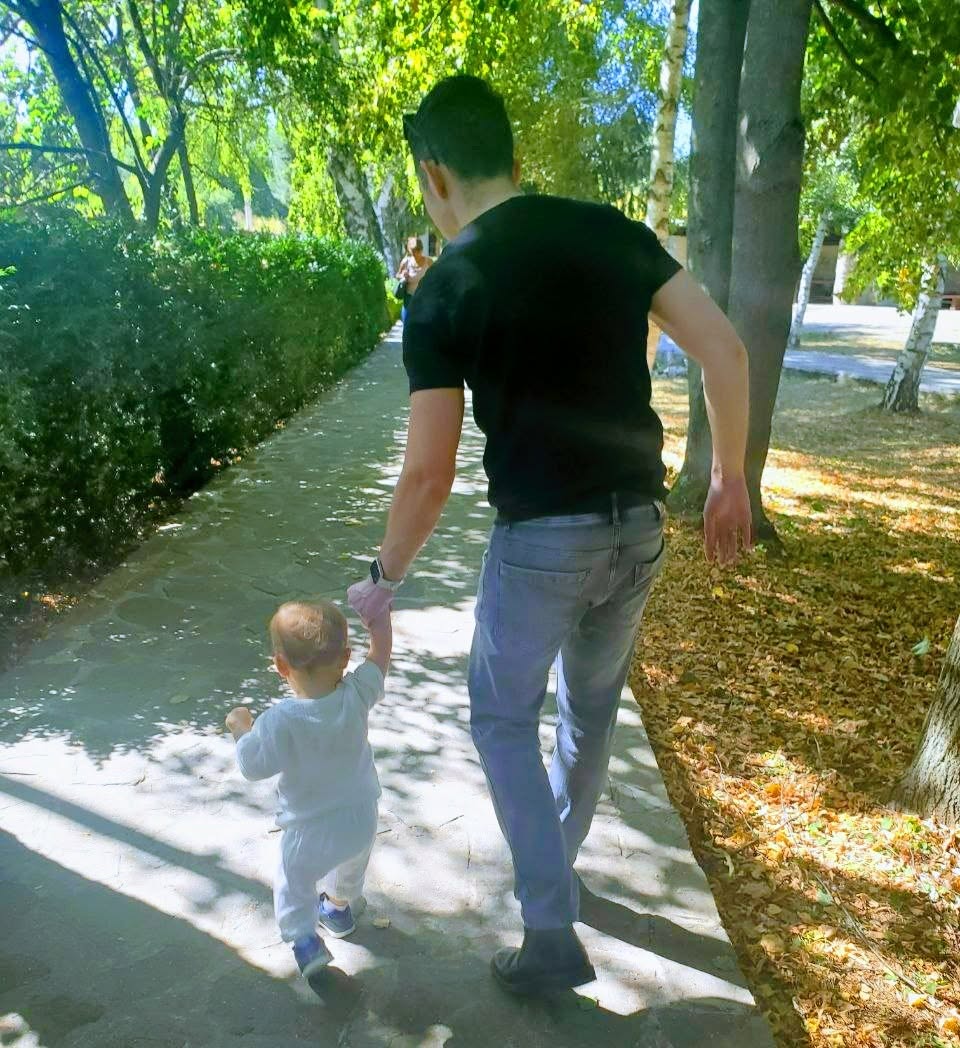 Leading the way
As a parent, you also end up thinking really seriously about the future. You no longer think mere months or years ahead, but decades and even centuries. You question how we might architect a more "pro-human future" that will be a good place for your children to live. That's part of my reason for starting this podcast; I hope the conversations that proceed will have some edifying impact on our co-creation of this new intelligent lifeform which we'll share this planet with.
I'm an author
I spent 1300 hours writing an epic two-part SciFi/Cyberpunk series about a Biohacking cybercriminal who must save civilization from the same comet that destroyed Atlantis 12,800 years ago. The series is entitled Hourglass; which is a double entendre referring to the cyclical mysteries of time and womanly beauty.
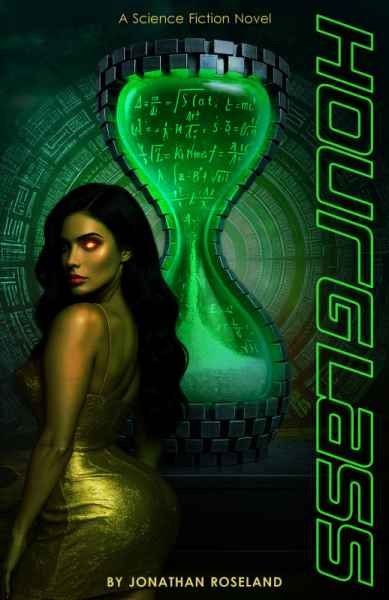

AI was my brainstorming partner throughout much of the writing process, and here's the interesting thing I noted: AI is fond of reminding us humans that we need to "touch grass" more; that we shouldn't become over-reliant on technology. If I had let AI write the whole story for me, Hourglass would have ended up being yet another cautionary tale about our species tiptoeing into techno-dystopia. But there's already a bunch of books and movies about that! What I thought would be more interesting is a story about lust; about how the individual's agency over their lust (or lack of it) might mirror cosmic cycles of civilizational destruction. So that's the story I wrote.
AI had a lot to do with this story being brought to life; admittedly, perhaps 10% of the writing is meta-prompted by me, written by AI. I used AI to create an "Odyssey of the Mind" style audiobook (that sounds a whole lot better than my gravely narrating 700 pages). I used AI filmmaking tools to create some epically cinematic trailers for Hourglass, but discovered I hate AI filmmaking!
Through here you can get Hourglass as a print, digital, or audiobook.
I'm a Christian Transhumanist
Which might have you scratching your head. Here's how I marry two ideologies that might seem like they couldn't be more contradictory...
As it stands, humanity has Paleolithic emotions and impulses, medieval institutions, and godlike planet-destroying technology (to paraphrase Edward O. Wilson). For our species to survive the next few centuries and pass Fermi's great filter, we need a serious upgrade. An upgrade of our intelligence and biology. We desperately need a lot more +150 IQ babies being born and wise centenarians around. Transhumanist technologies like CRISPR will get us there.
But for our species not to annihilate itself, we also need an upgrade in our ideology, philosophy, and morality. We need innovation of the most proven philosophical system: universalist morality. A modicum of universalist morality is what once made Western Civilization great; it was espoused most powerfully by Christ, but it was probably also shared by the Atlanteans many millennia before him, who seeded civilization around the world, raising megalithic architecture on multiple continents aligned to the same stars (yes, Atlanteans, I went there!
I did an interview with "Bulgaria's Indiana Jones" exploring that topic on my other podcast).
Christianity is the "meme" (an idea that takes on a life of its own) that has spread universalist morality the furthest. Bereft of the teachings of Christ, our society will descend into a truly dark dystopia. And, personally, it keeps me grounded, humble, and grateful, but I think that's all I'm going to talk about my faith on this podcast.
You may be wondering why I wear an eye patch. That's a long story; I explain the eye patch in an advanced personal growth episode of my other podcast. But that's enough about me...
About Limitless Intelligence: An AI Podcast
What to expect from this podcast...
-
More of this: Philosophically meaty deep-dives on the topic--I want to talk to the AI techno-optimists and the doomers; in fact, I'd love to host a debate. And I am open to guest suggestions.
- I think I'm pretty objective on AI: I'm not an AI fanboy nor an AI hater. I see tremendous upsides and concerning downsides to the technology.
-
Not "This Week in AI" - not going to cover the latest drama at OpenAI. The AI space moves scary fast, but I'm going to do my best to create evergreen conversations here.
-
Author interviews - Books are the best way to understand almost any topic. I'll be publishing some book reviews and interviewing some authors. Unlike a lot of podcasters, I actually read guests' books in completion; so I'm asking them challenging questions, not just the "softball interview questions" their PR agents pitch me.
-
Creative applications - Something that surprised me is that AI exploded into the mainstream in the last few years as a creative tool, as opposed to taking truckers' and janitors' jobs as had long been predicted by futurists. As a deeply creative person myself, I'm fascinated by how it might be used to multiply--NOT outsource--human creativity.
-
Latest tools - Most episodes are going to be more pragmatic than this one, as I'll be telling you about AI tools, techniques, and strategy. You have limited time, attention, and perhaps some money that you're willing to invest in how you use AI personally and professionally, and my goal is to help you avoid wasting any of those three precious resources on tools that might be wrong for you and your use case. So expect us to delve deeply into the various tools with various experts, teachers, and entrepreneurs...
No annoying ads will interrupt Limitless Intelligence episodes; yeah, I'm not trying to sell you a VPN, mattress, or random supplements here. Nor am I going to ask you to support me via donation or monthly Patreon subscription.
But this podcast is not a non-profit. Here's how I work: I will take on exclusive sponsors for some of the episodes; typically the company of person I'm interviewing. If I interview someone about AI filmmaking, for example, and you elect to listen to it, you're probably interested in AI filmmaking and might be willing to try whatever tool they've built. Here's why I work this way: I really value your time and attention, and I'd be wasting it by stuffing a bunch of unrelated ads into episodes. I'm a big believer in contextually relevant marketing; I only want to sell you what you actually want and tune in to hear about. Fair enough?
You've read all the way to the end...
So you must like what you've found here! So I'll ask you to do a few things right now...
-
Subscribe - to Limitless Intelligence on your preferred platform. It takes you literally just a second to hit that Subscribe button, and you have my commitment to putting out more thorough, thoughtful episodes like this one.
-
Comment - I'm genuinely excited to engage with the conversation that I think my provocative hypothesis could spark in the comments section and beyond! Feel free to ramble your thoughts into the chatbot of your choice and copy/paste them!
-
Share this - Wherever you are active on social media, especially in Facebook groups or forums where people are talking about AI, philosophy, and futurism. If you work in a quantum lab, an AI safety team, or a frontier LLM lab, pick one of these five experiments and run it. Prove me wrong, or show us the anomaly. Let's get the "6 degrees" working for us here; there must be someone listening to this episode now who can get it on the desk of someone who can actually test my provocative hypothesis. I'd love to report back on the results, whatever they are!
-
Follow me - After subscribing, you can follow me on Twitter/X; that's my main social media platform where I engage with the public. Sometimes I use X to collect questions for Q&A or survey the public.
-
Join the newsletter - The best way to stay in touch and never miss a new episode is to join the Limitless Intelligence newsletter. Don't worry! This just signs you up for our informative weekly newsletter (actually worth reading), NOT an aggressive automated marketing machine.
At the end of my podcasts, I like to append just a bit of extra entertainment value: AI songs. Yes, I know you're probably already OVER the novelty of AI songs. But I do this, frankly, because there's a surprising amount of tedious work that goes into producing good content like this, and creating AI songs is something I just find really fun.
Finally...
Join the Limitless Intelligence Newsletter to...
Never miss a new episode, and get ahead of the AI curve. This informative (and often entertaining!) newsletter is about how to take advantage of the latest tools, and where I dispense timely tips, hacks, and my own musings.Don't worry! This just signs you up for our informative weekly newsletter (actually worth reading), NOT an aggressive automated marketing machine.

 on twitter